Inve Learning Series
Intrinsic Value & DCF for Beginners (India)
Intrinsic value in plain words: a business is worth the cash it will produce, discounted for time and risk. The mango-tree way to value a real Indian stock.
By Inve Research Desk · 22 June 2026 · Updated 14 July 2026
Published by Inve Research Desk
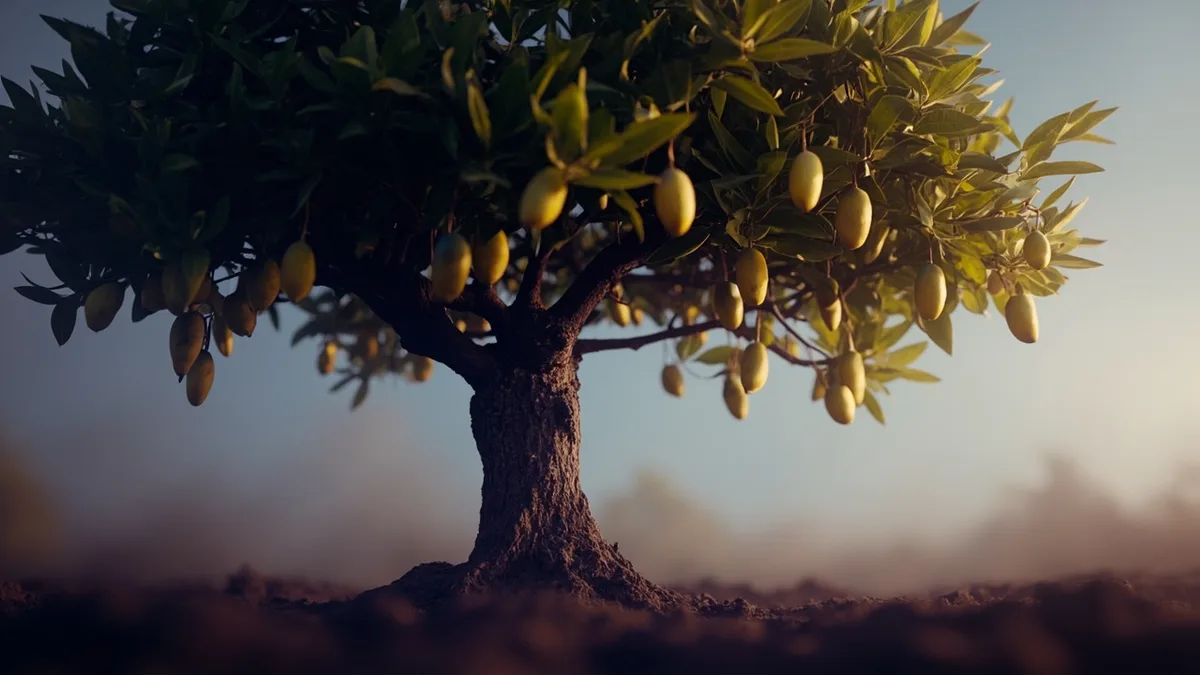
My grandfather had a mango tree in the backyard, and one summer a neighbour offered to buy it. Not the mangoes — the whole tree, standing. My grandfather thought for a day and named a price. When I asked how he picked it, he didn't say "market rate" or "what trees go for." He said: count the baskets of fruit it will give before it dies, decide how sure you are it'll keep bearing, and remember a basket twenty years out is worth less to you than a basket this June.
He had, without a spreadsheet or a single term of finance, just described how to value any business on earth. That is intrinsic value. That is a discounted cash flow. The rest of this article is only his sentence, slowed down.
A business is worth the cash it will hand you
Forget the share price for a moment. The intrinsic value of a business is the total cash it will put in its owners' pockets over its remaining life — adjusted for the fact that money arriving later is worth less than money arriving now. That adjustment is the "discount" in discounted cash flow (DCF): a method that takes future cash and translates it back into what it's worth to you today.
This isn't a modern invention. The cleanest definition came from John Burr Williams in 1938, and Warren Buffett condensed it in his 1992 letter to shareholders: "The value of any stock, bond or business today is determined by the cash inflows and outflows — discounted at an appropriate interest rate — that can be expected to occur during the remaining life of the asset." (Berkshire Hathaway, 1992 letter)
A tree, a toll road, a flat you rent out, a foods company — all the same machine underneath. You pay a price today to receive a stream of cash tomorrow. Price is what's on the tag. Value is what the stream is worth. The whole game is buying the second for less than it's worth, and the first is just what you happen to have to pay.
Buffett's three questions — which are my grandfather's
Buffett later traced the idea even further back. In his 2000 letter he credited the formula to Aesop, around 600 B.C., whose line was "a bird in the hand is worth two in the bush." To turn that proverb into a number, Buffett wrote, "you must answer only three questions. How certain are you that there are indeed birds in the bush? When will they emerge and how many will there be? What is the risk-free interest rate?" (Berkshire Hathaway, 2000 letter)
Swap birds for mangoes and you have my grandfather's exact reasoning:
- How sure are you the fruit keeps coming? (the certainty of the cash — its quality and durability)
- When, and how much? (the size and timing of the cash)
- What's the risk-free rate? (what safe money earns instead — your yardstick for "later is worth less")
That third one needs a name in our market. The risk-free rate is roughly what you'd earn lending to the government, which is treated as certain to pay you back. In India the usual stand-in is the 10-year government bond yield — about 6.85% as of June 19, 2026 (Trading Economics, June 2026). If a safe government bond hands you ~6.85% a year for doing nothing, then a risky business has to clear a higher bar than that to be worth owning. That higher bar is your discount rate. The more uncertain the fruit, the steeper you discount it — the fewer rupees you'll pay today for a rupee due in 2036.
"a bird in the hand is worth two in the bush" — Aesop, by way of Buffett
Let's value a real tree: Nestlé India
Pick a business that behaves like a healthy fruit tree — predictable, hard to kill, the same crop every year. Nestlé India, the maker of Maggi, Nescafé and KitKat, fits. Two-minute noodles, instant coffee and chocolate are dull, repeat-purchase products woven into every kitchen shelf and every chai break in India. Dull is the point: dull is predictable, and prediction is the whole job here. (To be clear, this is a teaching example, not a buy or sell call on Nestlé India.)
Here's the fruit this tree actually bore. In FY26 Nestlé India earned about ₹3,544 crore of net profit on roughly ₹23,155 crore of sales, with operating margins near 23% — and that profit has climbed steadily from about ₹3,196 crore in FY24 to ₹3,314 crore in FY25 to ₹3,544 crore in FY26 (Inve data, 2026). Three years, three bigger harvests. That earns per share about ₹18 of profit across its ~193 crore shares (Inve data, 2026).
Now apply my grandfather's three questions:
Is the fruit certain? Largely. Nestlé India carries almost no debt — its operating profit covered its tiny interest bill about 34 times over in FY26 (Inve data, 2026), so almost none of the cash is owed to lenders before it reaches owners. A business that doesn't owe the bank has far steadier fruit than one servicing a mountain of debt. (Why debt poisons the cash stream is its own subject — see how to spot a debt-trap stock.)
How much, and growing how fast? Steadily up, as the three-year run shows. Whether that continues is the one thing you must judge — and judge conservatively.
What's it worth today, against safe money? That's the discount step, and here's where intuition beats arithmetic. If a tree gives you ₹100 of fruit every year forever and you demand, say, a 10% return to bother with its risks, that perpetual stream is worth roughly ₹1,000 today — ten years of fruit, because the far-off baskets discount down toward nothing. Demand 12% instead and the same tree is worth only ~₹833. Nothing about the tree changed; only your patience and your read of the risk did. The discount rate is just how much you trust the future — turned into a price.
What this teaches that a price chart never will
Notice what we didn't do. We didn't look at whether Nestlé India's price went up last week. We counted the fruit and asked what the stream is worth. When you do that, the market price stops being the answer and becomes the question: at roughly ₹1,431 a share (Inve data, 2026), the market is paying about 78 times one year's profit. In mango terms, it is paying for nearly eighty baskets up front. That is a steep price — it only makes sense if you believe the tree will give far bigger harvests for a very long time. DCF doesn't tell you the market is wrong. It tells you exactly what you must believe to agree with it. You can see what growth an Indian stock's price already assumes with Inve's reverse-DCF calculator.
And that's the quiet power of the method: it converts a vague worry — "isn't this expensive?" — into a clear, checkable belief about future cash. A high price isn't a verdict; it's a bet on the harvest. Your job is to decide whether the bet is reasonable. (Running this logic backwards — asking what growth the price already assumes — is its own useful drill: see reverse DCF, what the market expects.)
See it on a live earnings call
Browse AI-analysed concall summaries — guidance tables, graded Q&A, and the quotes behind them — for 1,500+ listed Indian companies.
Browse concall summariesWhere DCF can lie to you
Munger's rule is that you don't own an opinion until you can argue the other side, so here's the honest case against everything above. A DCF is only as good as the fruit you forecast, and the future fruit is a guess. Change the growth rate by two percentage points or the discount rate by one, and the "value" can swing 40%. The math feels precise; the inputs are anything but. Buffett himself prefers a business so predictable that the forecast is almost boring — which is exactly why a Nestlé India is a fairer subject for this exercise than a loss-making startup whose "birds" are pure imagination. The shortcut version, DCF without the spreadsheet, keeps the thinking and drops the model.
So treat a DCF as a thinking tool, not an oracle. Its real gift isn't the final number; it's forcing you to write down your assumptions about the harvest — and then watch whether reality agrees. That last part is where most investors quietly give up. They build the forecast once and never check it. But a company tells you every quarter, on its earnings call, whether the fruit is coming as expected. Nestlé India, for instance, has held its operating margin in a steady 21–26% corridor quarter after quarter — a pattern about the future cash machine that you can mark against what management guides to and actually delivers (Inve data, 2026). Tracking that — does management's guidance about future cash keep coming true, across every stock you own, quarter after quarter — is the unglamorous discipline a DCF demands and almost nobody sustains by hand. It's the job a tool like Inve's Promise Tracker exists to do.
A valuation is a forecast wearing a suit. The suit doesn't make it true. The fruit does.
Frequently asked questions
No — and most great investors rarely do. The value of DCF is the thinking, not the model: a business is worth the cash it will produce, discounted for time and risk. If a company's future cash is too hard to forecast, the honest answer is to skip it rather than torture a spreadsheet into a false precision.
There's no single correct number, which is why DCF is judgement, not arithmetic. The floor is the risk-free rate — the ~6.85% a 10-year Indian government bond yields in mid-2026 — and a risky business must clear a meaningfully higher bar than that. The riskier and less predictable the cash, the higher the rate you demand, and the less you'll pay today.
Because money in hand can be put to work and safely grow — even a government bond pays you to wait. So a rupee arriving in ten years is worth less than a rupee now; you "discount" it back to compare like with like. That single idea — time has a price — is the whole engine of DCF.
Not on its own. Intrinsic value tells you what a business is worth if your forecast holds; it says nothing about whether your forecast is right or whether a cheaper, more certain opportunity sits next to it. Use it to understand what the price is assuming — then pair it with a margin of safety so you're not betting on a perfect harvest. This is education, not investment advice.
Test yourself
1/3. In plain words, what is the intrinsic value of a business?
2/3. Why is a rupee of profit arriving ten years from now worth less than a rupee today?
3/3. You raise your required return (discount rate) from 10% to 12% on the same business. What happens to its intrinsic value?